

Overview: Why GST/HST Collection Is Harsher Than Income Tax
If the Canada Revenue Agency has assessed your business for unremitted GST/HST, the protections you may have heard about for income tax debts do not apply. There is no 90-day waiting period, and filing an objection or appeal does not stop the CRA from collecting. The GST/HST you charged is treated as trust money that was never yours to keep, so the CRA can freeze your bank account, garnishee your receivables, and pursue you personally as a director while your dispute is still outstanding.
This guide explains the limits that do exist on GST/HST collection, and the ones that do not. It covers the 10-year collection limitation period and the ways it resets, the CRA’s enforcement toolkit under the Excise Tax Act, directors’ liability under section 323, derivative assessments against people who received property from the debtor, and the practical steps an experienced Canadian GST/HST tax lawyer uses to slow or stop enforcement.
For the general collection framework that applies across all tax types, see our CRA tax collections guide.
Background: GST/HST Is Trust Money
When a business collects GST/HST from its customers, it does so as an agent of the Crown. The tax is deemed to be held in trust for the Receiver General under the Excise Tax Act, separate and apart from the business’s own money. That single idea drives everything that follows. Because the funds are trust money rather than an ordinary debt, Parliament gave the CRA faster and stronger collection powers for GST/HST than for most income tax balances.
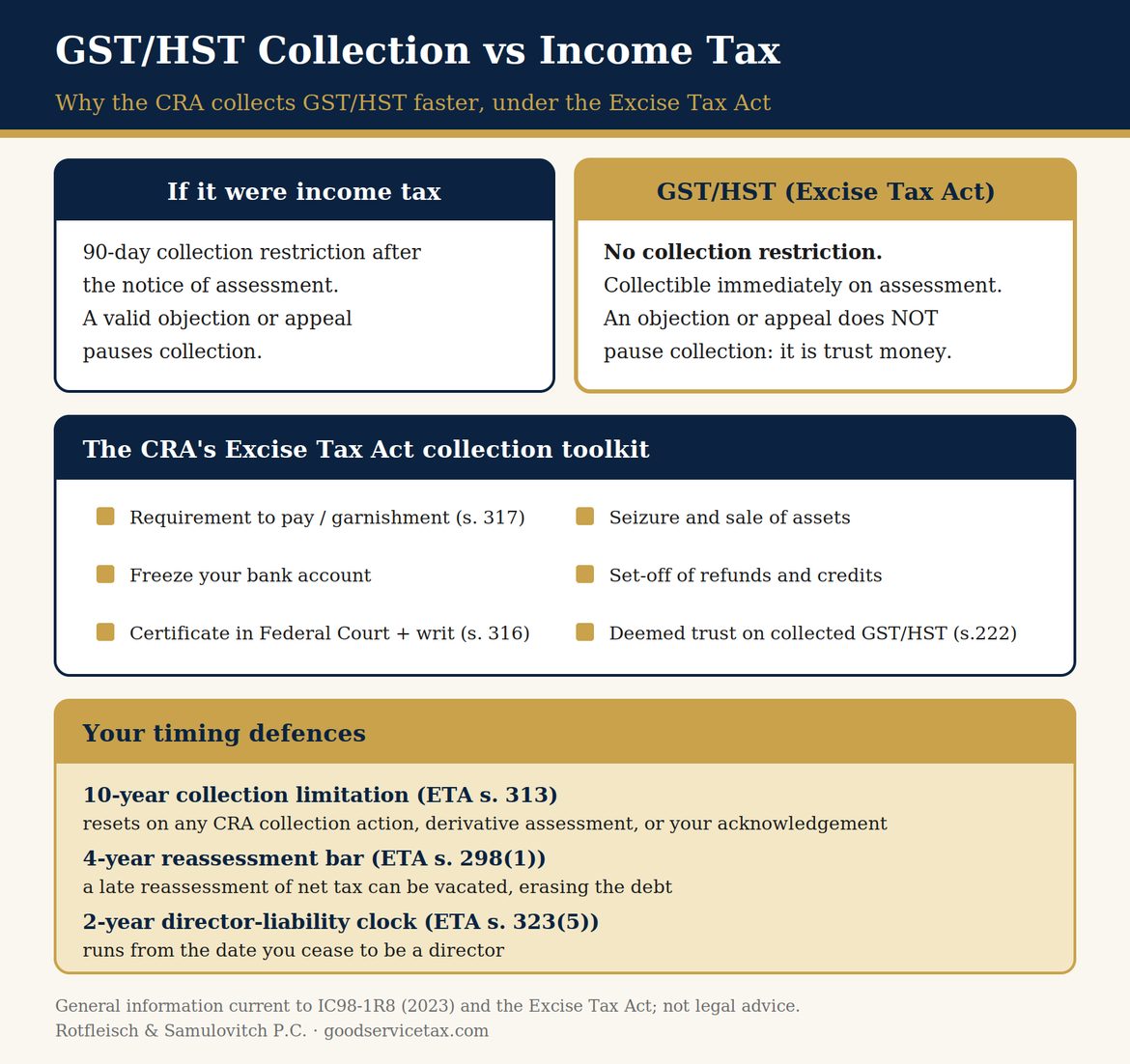
The practical consequence surprises most business owners. Under the Income Tax Act, the CRA generally cannot take legal collection action on ordinary income tax for 90 days after a notice of assessment, and a valid objection or appeal pauses collection further. There is no equivalent in the Excise Tax Act. As the CRA itself states in Information Circular IC98-1R8, Tax Collections Policies, there are no collection-restriction provisions in the Excise Tax Act at all.
“The hardest lesson for a business owner is that the GST/HST they collected was never their money to spend, so the usual objection-pauses-collection rule simply does not exist,” says David J. Rotfleisch, founding tax lawyer and CPA at Rotfleisch & Samulovitch, and a Law Society of Ontario Certified Specialist in Taxation. “You can be fighting the assessment and watching your bank account get frozen on the same day.”
Key Issues and Findings: What the CRA Can Do, and the Real Limits
No collection restriction: the CRA can act immediately
Once the CRA issues a notice of assessment or reassessment for GST/HST, the debt is collectible at once. The CRA does not wait 90 days and does not pause for a dispute. We explain how this plays out even in the middle of an audit in our analysis of whether the CRA can assess and immediately collect GST/HST even during an audit.
A 2026 decision shows how little room a taxpayer has here. In Harris v. The King, 2026 TCC 89, the Tax Court of Canada dismissed a taxpayer’s motion to stop the CRA from garnisheeing funds for unremitted GST/HST on the sale of ten condominium units while his appeal was still pending, and to return what had already been taken, and it awarded costs against the taxpayer.
The Court held that it is a statutory court without jurisdiction to grant that relief: under section 299 of the Excise Tax Act an assessment is valid and binding unless and until it is vacated on objection or appeal, and, unlike the Income Tax Act, the Excise Tax Act contains no statutory stay of collection while an appeal is outstanding. An injunction against CRA collection falls within the exclusive jurisdiction of the Federal Court of Canada, not the Tax Court, so that is the only route to halt collection.
The GST/HST enforcement toolkit
The Excise Tax Act equips the CRA with the full range of collection tools, and it can use them without first obtaining a judgment:
- A requirement to pay that garnishees your bank account or your accounts receivable, redirecting funds owed to you straight to the CRA.
- Registration of a certificate in the Federal Court of Canada, which then has the force of a judgment and lets the CRA obtain a writ and have a sheriff seize and sell property.
- Set-off, applying your income tax refunds, GST/HST credits, and other credits against the debt.
- Enforcement of the deemed trust over collected GST/HST, which ranks ahead of most other creditors.
The 10-year collection limitation period, and how it resets
The one genuine timing limit is the collection limitation period. Subsection 313(2.1) of the Excise Tax Act bars the CRA from commencing or continuing an action to collect a GST/HST debt after the end of the limitation period, which is 10 years. The trap is that the clock restarts. Under subsection 313(2.3) the period resets whenever the CRA takes a collection action, whenever the CRA issues a derivative assessment against a third party, or whenever the taxpayer acknowledges the debt. Acknowledgement is defined in subsection 313(2.4) and includes a written promise to pay, a written acknowledgement of the debt, and a payment, including a payment that is dishonoured such as a bounced cheque.
A collection action is defined broadly in subsection 313(1) and includes a court proceeding and steps taken under Division VIII of Part IX of the Excise Tax Act, such as a demand to file under section 282 or a demand to keep records under section 286. An older debt is not necessarily a dead debt: if the CRA assessed in 2005 and took collection action through 2015, it has until 2025 to collect, because each action restarts the 10 years.
One further wrinkle catches historical debts. Subsection 313(2.8) awakened all GST/HST debts that predated March 3, 2004, giving them a fresh limitation period that, absent a reset, could run to March 3, 2014.
“Clients think a quiet debt is a dead debt, and then one phone call undoes a decade,” Rotfleisch adds. “Before you promise the CRA anything, or send a single payment on an old balance, find out whether the limitation clock is about to run, because the wrong move hands the CRA another 10 years.”
Directors can be held personally liable
Section 323 of the Excise Tax Act lets the CRA pursue a corporation’s directors personally for unremitted GST/HST. Three features matter.
- Under subsection 323(2), the CRA generally cannot assess a director until it has tried and failed to collect from the corporation, for example where a certificate against the corporation is returned unsatisfied or the corporation has become bankrupt or been dissolved.
- Under subsection 323(3), a director has a due-diligence defence if he or she exercised the degree of care, diligence, and skill to prevent the failure that a reasonably prudent person would have exercised in comparable circumstances.
- Under subsection 323(5), there is a two-year limitation period that runs from the date a person last ceased to be a director, which is why a properly documented resignation can start a clock that eventually defeats a director’s liability assessment. We set out the rules and defences in our directors’ liability guide.
Transfers of property and the four-year reassessment limit
Two further provisions round out the picture. Section 325 of the Excise Tax Act lets the CRA assess a person who received property from a GST/HST debtor at less than fair market value while the debtor owed tax, for the shortfall between the value given and received. Like its Income Tax Act counterpart, section 325 carries no limitation period. Separately, subsection 298(1) generally prevents the CRA from reassessing net tax more than four years after the return was filed, which can eliminate the underlying GST/HST debt, and with it a director’s exposure, where the CRA has missed the window.
Practical Implications for Business Owners and Directors
- An objection or appeal does not stop GST/HST collection, so a separate conversation about a payment arrangement or a hold is essential, and it should happen before the bank account is frozen.
- A payment arrangement acceptable to the CRA, not a hardship claim on its own, is what secures the release of a requirement to pay.
- Penalties and interest can often be reduced through a taxpayer relief application, which is a separate track from disputing the net tax.
- For a director facing exposure, a properly documented resignation starts the two-year limitation period under subsection 323(5), and a notice of objection to the corporation’s reassessment may delay or eliminate the personal assessment.
- Never acknowledge or make a payment on an old GST/HST balance without first checking the limitation period, because the wrong step resets it.
Takeaway
GST/HST collection runs on a faster and harder track than income tax. There is no 90-day shield and no pause for a dispute, because the tax is trust money. The real limits are the 10-year collection period, which resets easily, the four-year reassessment window under subsection 298(1), and the two-year director-liability period under subsection 323(5). Each of these is a timing defence that rewards early, careful action and punishes an unguarded phone call. If the CRA has assessed your business or you personally as a director, the time to involve a tax law firm is before you respond, not after enforcement begins.
Pro Tax Tips: Protecting Yourself From GST/HST Collection
- The most valuable move a business owner can make is to treat a GST/HST arrears differently from an income tax balance of the same size, because the CRA can act on it immediately and will.
- Keep corporate GST/HST filings and payments current during any payment arrangement, since a new default can collapse the arrangement and expose directors.
- If you are a director who has stepped away from a company, document the resignation properly and keep proof of the date, because the two-year limitation period under subsection 323(5) only protects you if you can show when it started.
- And before you communicate with a collections officer about an older debt, have an experienced Canadian GST/HST tax lawyer confirm whether the collection limitation period has reset, so that an attempt to cooperate does not quietly restart the CRA’s 10-year window.
Frequently Asked Questions
Does the CRA have to wait before collecting a GST/HST debt?
No. Unlike ordinary income tax, there is no 90-day collection-restriction period for GST/HST. The CRA can begin collection as soon as it issues the notice of assessment or reassessment, because collected GST/HST is trust money.
How long does the CRA have to collect a GST/HST debt?
Generally 10 years, under subsection 313(2.1) of the Excise Tax Act. The period restarts each time the CRA takes a collection action, issues a derivative assessment, or the taxpayer acknowledges the debt, so for an active file it rarely expires on its own.
What counts as acknowledging the debt?
Under subsection 313(2.4), a written promise to pay, a written acknowledgement of the debt, or a payment, including a dishonoured payment such as a bounced cheque. Any of these resets the 10-year limitation period.
Can the CRA freeze my bank account over GST/HST?
Yes. The CRA can issue a requirement to pay to your bank, which will typically freeze the account and remit the funds to the CRA. It does not need a court judgment to do so.
Can I be held personally liable for my corporation’s GST/HST?
Potentially, under section 323 of the Excise Tax Act, if the corporation failed to remit and the CRA cannot collect from it. You may have a due-diligence defence under subsection 323(3), and there is a two-year limitation period under subsection 323(5) that runs from when you ceased to be a director.
Does resigning as a director stop the CRA?
Resigning does not erase an existing liability, but a properly documented resignation starts the two-year limitation period under subsection 323(5). If the CRA does not assess you within two years of your resignation, it is generally barred from doing so.
Can the CRA pursue my spouse or a family member?
It can under section 325 of the Excise Tax Act if you transferred property to a non-arm’s-length person for less than fair market value while you owed GST/HST. The recipient becomes liable for the shortfall, and section 325 carries no limitation period.
Can the underlying GST/HST assessment be too late?
Often, yes. Subsection 298(1) generally bars the CRA from reassessing net tax more than four years after the return was filed. A successful challenge to a late reassessment can eliminate both the corporate debt and a director’s personal exposure.
Can penalties and interest on GST/HST be reduced?
Yes, through a taxpayer relief application, which asks the CRA to waive or cancel penalties and interest in circumstances such as financial hardship or CRA delay. It is separate from disputing the net tax, and the two can run together.
Does filing an objection or appeal stop the CRA from collecting GST/HST?
No. Unlike income tax, filing a notice of objection or an appeal to the Tax Court of Canada does not pause GST/HST collection. In Harris v. The King, 2026 TCC 89, the Tax Court confirmed that it has no power under the Excise Tax Act to stay collection while an appeal is pending. That’s because the assessment stays valid and binding unless it is vacated. A Federal Court injunction is the only court route to halt collection, and it is difficult to obtain. A payment arrangement or collection hold negotiated with the CRA is usually the most practical way to protect your business while the dispute is resolved.
Can the CRA garnishee my business invoices if I am self-employed?
Yes. Where you are self-employed or a contractor, the CRA can issue a requirement to pay to your clients and redirect up to the full amount they owe you, such as unpaid invoices or accounts receivable, rather than the roughly one-half ceiling it applies to an employee’s wages. A single requirement to pay can divert your receivables before you ever see them, which is why the self-employed should act at the first sign of GST/HST arrears.
What should I do first if the CRA is collecting GST/HST from me?
Speak with an experienced Canadian GST/HST tax lawyer before contacting the collections officer. The first goal is to stop or prevent enforcement with an acceptable arrangement, protect any limitation-period defence, and only then address the underlying assessment.
DISCLAIMER: This article provides broad information. It is only accurate as of the posting date. It has not been updated and may be out-of-date. It does not give legal advice and should not be relied on as tax advice. Every tax scenario is unique to its circumstances and will differ from the instances described in the article. If you have specific legal questions, you should seek the advice of a Canadian tax lawyer.